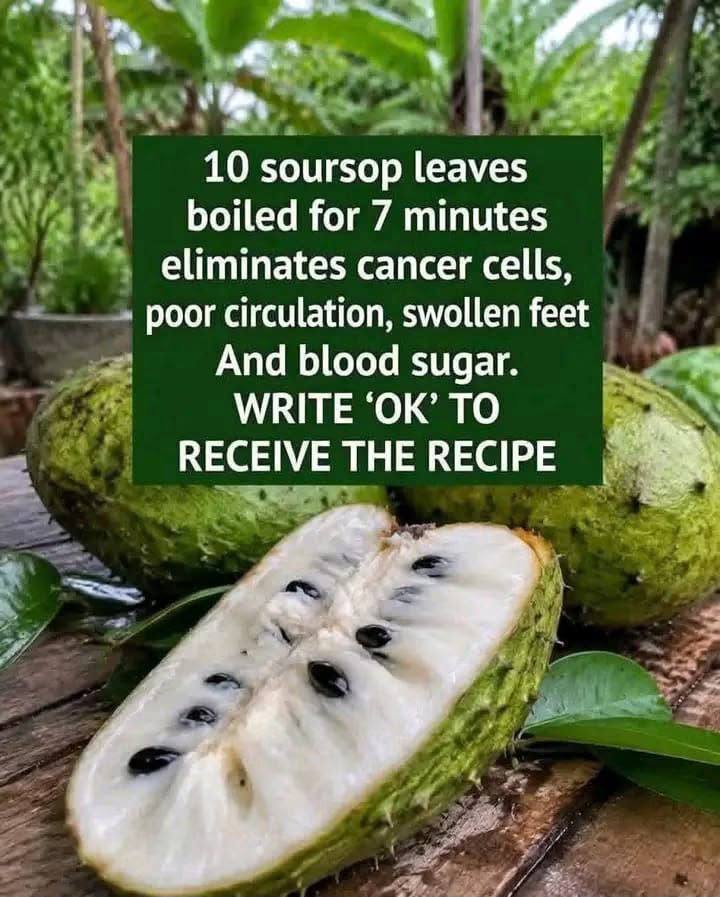
Soursop, also known as graviola or Annona muricata, is a tropical fruit tree that has attracted attention for both its fruit and its leaves. The leaves are sometimes prepared as an herbal tea, particularly in traditional practices.
Online posts often describe soursop leaf tea as a powerful natural remedy for cancer, poor circulation, swollen feet, and high blood sugar. However, these claims are much stronger than the available evidence supports. Soursop leaves contain several biologically active compounds, and researchers have studied them in laboratory settings, but this does not mean that a homemade tea can treat serious diseases.
The safest way to approach soursop leaves is to distinguish traditional use and early scientific research from proven medical treatment.
What Is Soursop?
Soursop is the fruit of the Annona muricata tree. It is also known in some places as graviola or guanabana.
The fruit has green, textured skin and soft white flesh containing dark seeds. It is commonly eaten fresh or used in juices, smoothies, desserts, and other foods.
The leaves are different from the fruit. They contain various natural compounds that have been studied by researchers, including compounds belonging to a group called acetogenins.
Because of these compounds, soursop has attracted scientific interest. However, the presence of biologically active substances does not automatically make the plant a safe or effective medicine.
Soursop Leaves as Herbal Tea
Soursop leaves are traditionally prepared in some communities as an infusion or tea.
A common preparation involves washing leaves and placing them in hot water. Some recipes recommend boiling several leaves for a specific number of minutes.
It is important to remember that there is no universally established medicinal dose for soursop leaf tea. The number of leaves, their size, maturity, concentration, and preparation method can all affect what is present in the finished drink.
For this reason, viral recipes that claim that exactly “10 leaves boiled for 7 minutes” will treat several diseases should not be treated as medically established instructions.
Can Soursop Leaves Kill Cancer Cells?
This is one of the biggest claims associated with soursop.
Researchers have investigated compounds from Annona muricata in laboratory studies. Some extracts and isolated compounds have demonstrated effects against certain cancer cell lines under experimental conditions.
That finding is interesting, but it does not establish that soursop leaf tea treats cancer in humans.
There is a major difference between a laboratory experiment and a clinical treatment. A compound may affect isolated cells in a laboratory while behaving very differently after it is consumed by a person.
Researchers also need to establish an effective dose, safety, absorption, interactions with other treatments, and whether the treatment actually improves outcomes in patients.
Therefore, soursop leaf tea should not be used instead of established cancer treatment.
Why Laboratory Results Can Be Misleading
Social media posts frequently take laboratory findings and turn them into statements such as “this plant kills cancer.”
The problem is that laboratory experiments often use concentrated extracts or purified compounds at controlled concentrations.
Drinking a homemade tea does not necessarily produce the same concentration in the bloodstream or inside a tumor.
The body also breaks down and processes substances after they are consumed.
A promising laboratory result can therefore be the beginning of scientific research rather than proof that a plant is an effective treatment.
This distinction applies not only to soursop but to many herbs, spices, fruits, and supplements.
Soursop and Blood Sugar
The image also claims that soursop leaves can eliminate or control blood sugar.
There has been research into soursop and glucose-related effects, including experimental studies. However, this does not establish that soursop leaf tea can safely treat diabetes.
Blood sugar needs to be managed carefully because both excessively high and excessively low glucose levels can cause serious problems.
Someone taking diabetes medication should be particularly cautious about consuming concentrated herbal preparations that might potentially affect blood glucose.
Soursop tea should never be used to replace prescribed diabetes medication or a treatment plan from a healthcare professional.
What About Poor Circulation?
Another claim is that boiling soursop leaves can improve poor circulation.
There is not enough reliable clinical evidence to recommend soursop leaf tea as a treatment for circulation problems.
Poor circulation can have many different causes. Problems involving blood vessels, the heart, diabetes, medications, or other health conditions may require very different treatments.
If someone has persistent cold or painful extremities, changes in skin color, numbness, significant swelling, or other circulation-related symptoms, the underlying cause should be evaluated.
A homemade herbal tea should not be relied upon to correct the problem.
Soursop Leaves and Swollen Feet
Swollen feet can occur for many reasons.
Standing for long periods, heat, minor injuries, and other temporary factors can sometimes contribute to swelling. However, swelling can also be associated with conditions affecting the heart, kidneys, liver, veins, or other parts of the body.
For this reason, claiming that soursop leaf tea simply “eliminates swollen feet” is misleading.
Sudden or severe swelling, especially when accompanied by pain, shortness of breath, chest discomfort, or swelling mainly affecting one leg, deserves prompt medical attention.
The appropriate treatment depends on the cause.
What Compounds Are Found in Soursop?
Soursop contains numerous naturally occurring compounds.
The plant has attracted particular scientific interest because of acetogenins, a group of compounds found in Annona species.
These compounds have been investigated for biological activity in laboratory research.
However, natural compounds can have both biological effects and potential toxicity. “Natural” does not automatically mean safe.
This is especially important when discussing concentrated extracts, supplements, or frequent consumption of medicinal preparations made from leaves.
Is Soursop Leaf Tea Safe?
Safety is an important part of the discussion.
Soursop leaves are not simply equivalent to an ordinary food such as a banana or apple. They contain biologically active compounds, and concerns have been raised about potential toxicity with repeated or concentrated exposure.
There is also concern about possible effects on the nervous system from compounds found in Annona muricata.
Because of these uncertainties, drinking large quantities of concentrated soursop leaf preparations is not something to approach casually.
People with medical conditions, those taking medication, pregnant or breastfeeding individuals, and anyone considering long-term use should speak with a healthcare professional before using soursop leaf products.
Soursop Tea vs. Soursop Fruit
It is useful to distinguish between the fruit and the leaves.
Soursop fruit is eaten as food in many countries. The leaves are more commonly discussed in the context of traditional herbal preparations.
Eating a normal serving of a fruit is not the same as consuming a concentrated preparation made from leaves.
Different parts of a plant can contain very different compounds and concentrations.
Therefore, information about the nutritional value of soursop fruit should not automatically be applied to soursop leaf tea.
Can You Make Soursop Leaf Tea?
If you are considering soursop leaf tea as a traditional beverage, it is better to avoid treating viral recipes as medically validated formulas.
Recipes online often specify an exact number of leaves and boiling time while promising treatment for several unrelated conditions.
There is no good reason to assume that a particular number of leaves or a particular boiling time creates a proven therapeutic dose.
If you are interested in using soursop leaves, especially regularly or for a medical purpose, discuss the product and preparation with a qualified healthcare professional first.
Why “Natural Cure” Claims Spread Online
Posts about herbal remedies often combine a familiar plant with dramatic promises.
A typical post may claim that one tea can simultaneously treat cancer, diabetes, circulation problems, swelling, high blood pressure, and other conditions.
These claims should immediately encourage careful evaluation.
Different diseases have different biological mechanisms. A single homemade tea claiming to treat many unrelated conditions would require substantial evidence before it could be considered a medical treatment.
Unfortunately, viral posts often provide a recipe without providing clinical evidence.
What Should You Do If You Have Diabetes?
If you have diabetes, do not stop prescribed medication because of a soursop recipe.
Keep following your healthcare professional’s instructions regarding medication, nutrition, physical activity, and blood glucose monitoring.
If you are interested in trying an herbal product, tell your doctor or pharmacist exactly what you plan to use.
This is particularly important because herbal products can sometimes interact with medications or affect blood sugar in unpredictable ways.
What Should You Do If You Have Cancer?
If you have cancer, discuss every supplement or herbal preparation with your oncology team before using it.
Cancer treatment can involve chemotherapy, radiation therapy, surgery, targeted treatments, immunotherapy, hormone therapy, or combinations of these approaches.
Some herbs and supplements can potentially interfere with medications or affect how treatments work.
Most importantly, do not delay or replace cancer treatment with soursop leaf tea based on claims made in social media posts.
A More Realistic Way to View Soursop
Soursop is an interesting tropical plant with a long history of culinary and traditional use.
Its fruit can be enjoyed as food, while its leaves have been used in traditional preparations in some cultures.
Researchers continue to investigate compounds found in the plant because some have interesting biological properties in laboratory studies.
That research is worth following, but it should not be confused with proof that soursop leaf tea cures disease.
A responsible description is much simpler: soursop leaves are traditionally used in herbal preparations, but their effectiveness and safety as a treatment for serious diseases have not been established.
Final Thoughts
Soursop leaf tea is often promoted online as a powerful natural treatment for cancer, diabetes, poor circulation, and swollen feet. The image claims that a specific preparation can eliminate all of these problems.
Those claims go far beyond what current evidence can support.
Research into soursop and its naturally occurring compounds is ongoing, and some laboratory findings are scientifically interesting. However, laboratory activity does not prove that drinking soursop leaf tea treats cancer or other diseases in humans.
Soursop leaves also deserve caution because concentrated or repeated use may not be risk-free.
If you enjoy soursop fruit as part of your diet, that is different from using the leaves as a medicinal treatment. And if you have a serious medical condition, the safest approach is to seek appropriate medical care rather than relying on a viral herbal recipe.
A traditional herbal drink can be interesting without being presented as a cure.