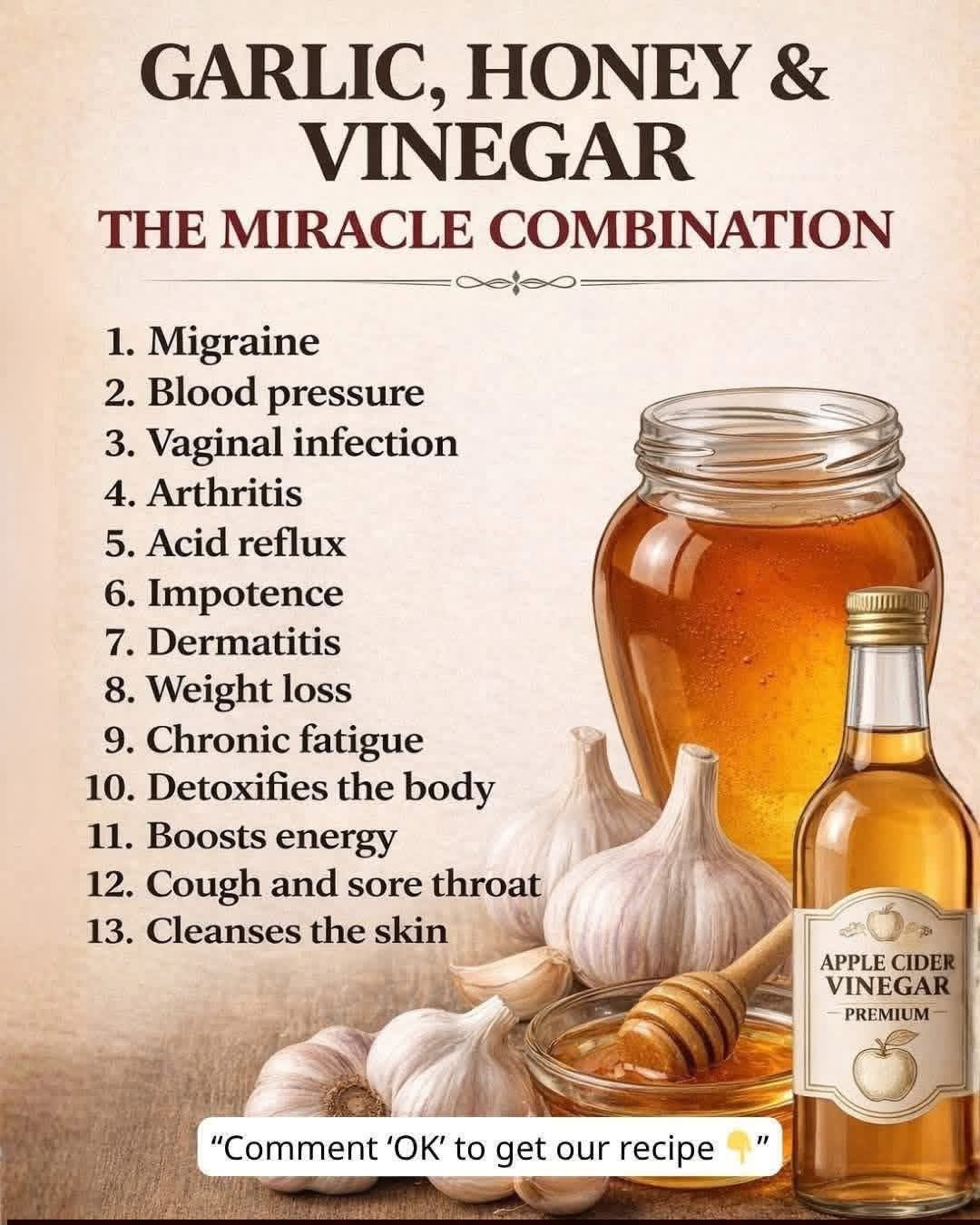
The image claims that a mixture of garlic, honey, and apple cider vinegar can help with 13 different conditions, including migraines, high blood pressure, vaginal infections, arthritis, acid reflux, weight loss, chronic fatigue, cough, and skin problems.
Garlic, honey, and vinegar are all common foods with some interesting properties. However, calling their combination a “miracle” treatment goes far beyond what the scientific evidence supports.
What does science actually say?
1. Blood pressure
There is some evidence that garlic preparations may produce a small reduction in blood pressure in people who already have hypertension. However, the evidence is limited, and the effects are much smaller than those expected from standard blood-pressure medicines.
Some research has also investigated vinegar and blood-pressure effects, but this doesn’t establish that combining vinegar with garlic and honey is an effective treatment.
So:
Garlic may have a modest effect on some cardiovascular risk factors, but this mixture should not replace prescribed treatment for hypertension.
2. Cholesterol and heart health
Garlic has probably been the most studied ingredient in this mixture.
Research suggests that garlic supplements may modestly reduce total and LDL cholesterol, particularly in people with elevated cholesterol. But the effect is relatively small compared with cholesterol-lowering medications.
Importantly, this evidence concerns particular garlic preparations and supplements—not necessarily a homemade mixture of garlic, honey, and vinegar.
3. Weight loss
The graphic lists weight loss as one of the supposed benefits.
There is some recent research investigating vinegar consumption and body weight. A 2025 systematic review and meta-analysis of randomized trials reported reductions in body weight and BMI with apple cider vinegar in adults, although the studies varied considerably and the evidence doesn’t establish apple cider vinegar as a reliable weight-loss treatment.
Another important point: a previously published study involving Lebanese adolescents and young adults that claimed substantial benefits from apple cider vinegar was retracted in 2025, so it should not be used as evidence for the claim.
Therefore, the viral claim that this particular combination causes weight loss is not established.
4. Blood sugar
Apple cider vinegar has been investigated for glucose metabolism. Some systematic reviews have found improvements in certain glucose measurements, but the studies differ in their methods, populations, and amounts of vinegar used.
That doesn’t mean someone with diabetes should use this mixture instead of their treatment.
Similarly, garlic supplements have shown small effects on blood sugar in some studies, but the evidence isn’t enough to consider garlic a treatment for diabetes.
5. Migraine
There is no good evidence that garlic + honey + apple cider vinegar is a treatment for migraine.
Migraine can have different triggers and requires an appropriate management strategy. A homemade mixture shouldn’t be presented as a cure.
6. Arthritis
Garlic contains compounds with antioxidant and anti-inflammatory properties, which has led to research into possible effects on inflammation.
But that is very different from demonstrating that this three-ingredient mixture treats arthritis.
There isn’t sufficient clinical evidence to support the image’s claim that the mixture can treat arthritis.
7. Acid reflux
This claim is particularly questionable because vinegar is acidic.
Apple cider vinegar is sometimes promoted online as a remedy for reflux, but there isn’t good evidence that it treats acid reflux. Because vinegar itself is acidic, it can actually aggravate symptoms in some people.
Garlic can also cause gastrointestinal symptoms such as abdominal discomfort and heartburn in some people.
So someone with reflux shouldn’t assume that this combination will calm their symptoms.
8. Vaginal infections
This is one of the most concerning claims in the graphic.
Garlic, honey, or apple cider vinegar should not be used inside the vagina to try to treat an infection.
Vaginal symptoms such as itching, burning, unusual discharge, or odor can have several different causes, including bacterial vaginosis, candidiasis, and sexually transmitted infections. The CDC notes that symptoms alone may not be enough to determine the cause and that appropriate evaluation may require examination and laboratory testing.
The CDC also specifically notes that douching does not have evidence supporting it as treatment or symptom relief for bacterial vaginosis and may increase the risk of recurrence.
So this particular claim should not be followed.
9. “Impotence”
The image claims the mixture can treat impotence, now more commonly called erectile dysfunction.
There isn’t sufficient evidence that this combination treats erectile dysfunction. Erectile difficulties can have many causes, including vascular, hormonal, psychological, medication-related, and other medical factors.
A food mixture shouldn’t be presented as a proven treatment.
10. Dermatitis and skin problems
Garlic is sometimes used in traditional topical remedies, but that doesn’t make raw garlic safe to put on irritated skin.
In fact, NCCIH warns that fresh raw garlic applied to the skin can cause severe irritation and chemical burns.
So using raw garlic directly on dermatitis would be a particularly poor interpretation of this graphic.
11. Chronic fatigue and “boosting energy”
Honey contains carbohydrates and therefore provides energy as a food.
But that doesn’t mean the mixture treats chronic fatigue.
Persistent unexplained fatigue can have many possible causes, including sleep problems, nutritional deficiencies, infections, endocrine disorders, medication effects, and other medical conditions. Treating persistent fatigue requires finding the underlying cause rather than relying on a “detox” drink.
12. Cough and sore throat
This is the claim with the clearest evidence for one ingredient: honey.
Honey can provide relief from cough in people over 1 year old. The CDC lists honey as one option for relieving cough associated with a common cold or sore throat.
That doesn’t mean garlic and apple cider vinegar are necessary, nor does it mean the mixture cures the infection.
So this particular part of the graphic contains a kernel of truth, but it exaggerates it into a broad medicinal claim.
13. “Detoxifies the body”
This is one of the biggest red flags in the graphic.
Your body already has systems responsible for processing and eliminating substances, particularly the liver and kidneys. There is no established medical need for a garlic-honey-vinegar drink to “detox” a healthy person’s body.
“Detox” is frequently used in social-media health marketing without clearly defining what toxin is supposedly being removed.
Is the combination itself proven?
No.
There is research on individual ingredients, especially garlic and vinegar, but that does not prove that putting all three together creates a special therapeutic effect.
This is an important scientific distinction:
Evidence that ingredient A has a particular biological effect ≠ evidence that A + B + C treats 13 different diseases.
The studies also often use specific preparations, doses, or supplements rather than the homemade mixture shown in social-media posts.
Are there safety concerns?
Yes.
Garlic is generally safe in normal food quantities, but larger supplemental amounts can cause gastrointestinal symptoms and may increase bleeding risk, particularly when combined with anticoagulant or antiplatelet medicines.
Apple cider vinegar is acidic and can cause problems for some people, particularly if consumed inappropriately or if someone has certain medical conditions or takes particular medications. It can also aggravate reflux in some individuals.
And putting garlic or vinegar on/in sensitive tissues such as the vagina or irritated skin is not a safe way to treat an infection or dermatitis.
What about honey?
Honey is perfectly reasonable as a food for people older than 1 year, and it can help soothe coughs. The CDC specifically recommends avoiding honey in children younger than 12 months because of the risk of infant botulism.
But honey isn’t a cure for bacterial infections, arthritis, hypertension, or the other diseases listed in the image.
The claims at a glance