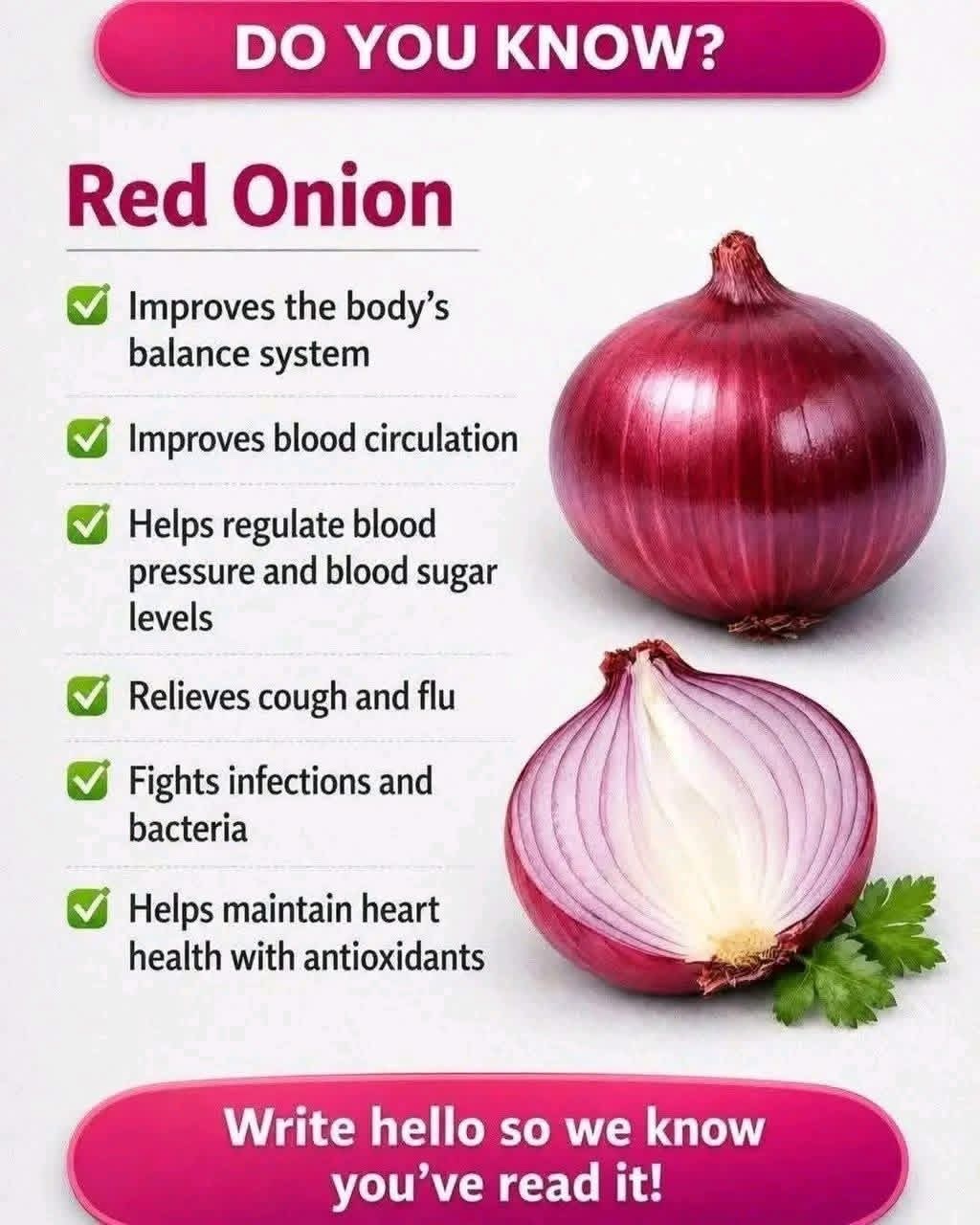
The image presents red onion as a food that can improve circulation, regulate blood pressure and blood sugar, relieve cough and flu, fight infections and bacteria, and support heart health. Some of these claims have a scientific basis, but the graphic makes them sound much stronger and more certain than the evidence supports.
Red onions are nutritious and contain compounds such as quercetin, a flavonoid with antioxidant activity. However, eating onions should be considered part of a healthy diet—not a treatment for hypertension, diabetes, infections, or the flu.
1. Red onion and antioxidants
Red onions contain several plant compounds, including flavonoids such as quercetin. These compounds have antioxidant properties and have been investigated for their potential effects on inflammation and cardiovascular health.
This helps explain why onions can be a useful part of a balanced diet. But there is an important distinction:
“Contains antioxidants” does not mean “prevents or cures disease.”
The amount of a particular compound in an ordinary serving of onion also isn’t equivalent to the doses used in studies of concentrated extracts or supplements.
2. Does red onion improve blood circulation?
The image says that red onion “improves blood circulation.”
This is an oversimplification.
Research has investigated quercetin, one of the compounds found in onions, for cardiovascular effects. Some meta-analyses of randomized trials have found modest reductions in blood pressure with quercetin supplementation. For example, one meta-analysis of 10 trials involving 841 participants found a small reduction in systolic blood pressure.
But that does not demonstrate that simply eating a red onion produces the same effect.
In fact, studies have produced mixed results, and some trials of quercetin from onion-derived products did not find significant improvements in vascular measures.
So the claim is better expressed as:
Red onions contain compounds being studied for cardiovascular effects, but eating red onion is not a proven treatment for poor circulation.
3. Can red onion regulate blood pressure?
There is somewhat more evidence here, but the graphic still exaggerates the conclusion.
A 2023 systematic review and meta-analysis examined 14 randomized controlled trials of onion supplementation and reported improvements in several metabolic parameters, including systolic blood pressure. The researchers also noted that effects varied according to duration and dosage.
However, this doesn’t mean that someone with high blood pressure can replace medical treatment with onions.
Blood pressure is influenced by many factors, including genetics, body weight, physical activity, sodium intake, sleep, stress, medications, and underlying medical conditions.
Eating vegetables—including onions—as part of a healthy diet can be beneficial, but red onion is not an antihypertensive medication.
4. What about blood sugar?
This claim needs even more caution.
Quercetin has been investigated for effects on glucose metabolism. One systematic review and meta-analysis found that quercetin supplementation did not significantly change fasting glucose, insulin resistance, or HbA1c overall. Some specific subgroups showed changes, but these results shouldn’t be interpreted as proof that onions regulate blood sugar.
Therefore, saying:
“Red onion regulates blood sugar”
is too strong.
A more accurate statement would be:
“Onions contain bioactive compounds that are being studied for possible metabolic effects, but they should not be considered a treatment for diabetes or high blood sugar.”
5. Does red onion relieve cough and flu?
This is another popular traditional-health claim.
People have used onions in home remedies for coughs and respiratory symptoms for a long time. However, traditional use is not the same thing as strong clinical evidence.
A red onion can certainly be included in food while someone has a cold, but there is insufficient evidence to say that eating red onion treats influenza or cures a respiratory infection.
If someone has influenza or another infection, appropriate medical care depends on the illness and its severity.
6. Does onion “fight infections and bacteria”?
There is an important distinction between laboratory research and treatment in humans.
Various compounds found in plants, including onions, can show antimicrobial activity under laboratory conditions. Quercetin itself has been studied for antioxidant, anti-inflammatory and antibacterial properties.
But a substance demonstrating antibacterial activity in a laboratory experiment doesn’t automatically mean that eating the food will eliminate a bacterial infection in a person.
That’s why the phrase “fights infections and bacteria” is misleading when presented without qualification.
Red onion can be a healthy food, but it shouldn’t be used instead of appropriate treatment for a bacterial infection.
7. Can red onion help the heart?
This is probably the most reasonable interpretation of the graphic, provided the claim is kept modest.
A diet rich in vegetables is generally associated with better cardiovascular health, and onions provide fiber and various plant compounds.
Research on onion supplementation has also reported changes in several cardiovascular and metabolic measures, although the evidence is not strong enough to turn onion into a medical treatment.
The image’s wording—“helps maintain heart health with antioxidants”—is therefore more reasonable than its claims about treating infections or regulating blood sugar, but it still shouldn’t be interpreted as a guarantee of cardiovascular protection.
8. Why red onions specifically?
Red onions are particularly interesting because their color comes partly from anthocyanins, while they also contain quercetin and other phytochemicals.
Different varieties of onions can have different concentrations of these compounds.
That doesn’t mean red onions are a “superfood” capable of treating diseases. It simply means they are one nutritious option among many vegetables.
A varied diet is much more important than relying on one particular food.
What the image gets right—and wrong